# Introduction to BENQI

BENQI is a suite of leading DeFi protocols built on [Avalanche](https://www.avax.network/). In a short period of time, BENQI has become the #1 application on Avalanche (by TVL) thanks to BENQI's core products, each with deep liquidity and extensive integrations across the DeFi landscape.

**BENQI's 4 core products include:**

1. [**BENQI Liquid Staking**](https://staking.benqi.fi)**:** For staking AVAX in exchange for sAVAX, deployable throughout DeFi while still earning staking rewards.
2. [**BENQI Markets**](https://app.benqi.fi/)**:** For lending borrowing, and earning interest on digital assets within both core and isolated markets.
3. [**Ignite**](https://ignite.benqi.fi)**:** For fast and easy deployment of  Avalanche validators, catering to institutions, developers, and Web3 users.
4. [**Node Voting:**](https://staking.benqi.fi/veqi/stake) For receiving AVAX delegations and rewards, if you run an AVAX validator by voting with [BENQI Miles.](/benqinomics/benqinomics)&#x20;

### BENQI Liquid Staking

BENQI tokenizes staked AVAX through liquid staking and issues **sAVAX**, a liquid staking token that is widely integrated throughout the Avalanche DeFi ecosystem.&#x20;

Users can stake directly from the Avalanche C-Chain, eliminating the need to bridge assets to the P-Chain. Additionally, users can hold, swap, or collateralize their sAVAX to earn additional yield while maintaining liquidity.

### BENQI Markets

Users can lend, borrow, and earn interest with their digital assets.

**Depositors** providing liquidity to the protocol earn yield, while **borrowers** can access funds through over-collateralized loans. All positions can be easily monitored through our newly designed user interface.

There are two primary markets:

* **Core Markets:** BENQI's primary lending and borrowing pools designed for highly liquid assets such as AVAX and USDC.
* **Avalanche Ecosystem Markets:** : Designed to support a broader range of assets, including long-tail crypto assets and tokenized real-world assets (RWAs). These markets feature specialized risk management to ensure that volatility or liquidity issues in one market don’t impact the others, providing more flexibility for DeFi users.

### Ignite

It can be technologically challenging to launch an Avalanche validator, and require significant upfront capital.

Ignite is BENQI’s solution that makes it **fast and easy to launch and run Avalanche validators and Subnets** with minimal little-to-no upfront capital and no technical complexities.&#x20;

Ignite offers two key options, allowing users to choose the one that best suits their needs:

* **Pay-As-You-Go (PAYG)**: Run a validator with no upfront AVAX by paying a weekly fee. Ideal for short-term use cases like MEV Solvers.
* **Stake**:  Stake QI and cover hosting fees to run automated validators and earn QI rewards without the need to manage any technical details.

### Node Voting

BENQI's liquid staking pool allocates AVAX to validators on the Avalanche network, using a 35/65 delegation split as follows:

* **BENQI Miles Pool (35%)**: Delegated based on community-driven votes, where BENQI Miles holders select specific validators through Node Voting.
* Open Pool (65%): Randomly allocated to all validators who meet the minimum criteria.

Therefore, Node Voting applies only to the BENQI Miles Pool.

It's the governance feature whereby holders of BENQI Miles tokens can support specific validators on the Avalanche network.  By voting with their BENQI Miles, users can influence how AVAX from BENQI’s Liquid Staking Pool is delegated to validators.&#x20;

Related to this are BENQI Miles, which have two options for accrual:

1. **Flex Option:** What exists today. Miles accrue gradually over time as users stake their QI, with full benefits accumulating after a specified period.
2. **Lock Option:** A planned feature that has not yet been implemented. Miles accrue instantly upon staking, but users face a delayed exit period when they choose to unstake.

## Risks

While BENQI is designed to minimize risks, no blockchain protocol is entirely risk-free. **Smart Contract risks** and **Liquidation risks** are potential considerations when interacting with the protocol. BENQI mitigates these risks by undergoing rigorous audits and maintaining a public, open-source codebase for transparency and security.

We covered these in further detail in the [Risks & Audits](/resources/risks) section.


# Overview

BENQI serves as a deep liquidity hub for the Avalanche ecosystem, with extensive integrations and possibilities for both new and established developers.

We recommend that there is significant potential for developers keen on building new products that leverage BENQI's liquidity pools, lending protocol, and liquid staking infrastructure.

If you would like to learn more, please [reach out via Discord](https://discord.com/invite/jyPAjZjwk6).

### Why Build with BENQI?

1. **Multi-Product Liquidity Hub:** BENQI combines various major DeFi primitives into a single platform with deep liquidity. Developers can create dApps that tap into these various liquidity pools. For example, advanced DeFi strategy applications like [Cian](https://cian.app/) or [Definitive](https://www.definitive.fi/).
2. **Avalanche Blockchain Benefits**: Built on Avalanche, BENQI leverages near-instant finality (around 1 second) and low fees, with cross-compatibility between virtual machines (VMs) and subnets. This makes it ideal for developers building fast and flexible applications that are highly scalable and interoperable.
3. **Long-Tail Asset Support:** BENQI’s isolated markets enable developers to create custom lending pools for new or volatile assets while mitigating risk. Isolated markets prevent one asset's volatility from affecting others, giving developers flexibility in designing custom collateral, liquidation rules, and lending structures.
4. **Comprehensive Subgraph and Smart Contract Access:** Developers can access historical and real-time data through BENQI’s subgraphs and smart contracts. This enables the development of tools like liquidator bots, analytics platforms, or DeFi dashboards. BENQI’s transparent on-chain data and flexible integration points make it highly customizable for various DeFi applications.
5. **Upcoming Innovations:** BENQI is constantly evolving, with upcoming features such as&#x20;
   1. Our RWA lending platform,&#x20;
   2. Additional swap integrations and&#x20;
   3. Improved governance through BENQI Miles.

Be the first to learn of new updates - [follow us on Twitter](https://x.com/BenqiFinance?ref_src=twsrc%5Egoogle%7Ctwcamp%5Eserp%7Ctwgr%5Eauthor)


# FAQ

### **What can I build with BENQI?**

Answer

### **How could I get started building?**

Answer

### **How can I find the sAVAX to AVAX exchange rate?**&#x20;

To check the exchange rate for sAVAX to AVAX, click the following link: [sAVAX to AVAX Rate](https://snowtrace.dev/address/0x2b2C81e08f1Af8835a78Bb2A90AE924ACE0eA4bE#readProxyContract-43114)

This can be read from the contract using **Function 14:** `sAVAX to AVAX`**or Function 18:** `AVAX to sAVAX`

### I**s there a contract call for burning sAVAX after users have redeemed it?**

Burning sAVAX is automated and only occurs when redeeming AVAX. Users cannot burn sAVAX directly. The redemption process triggers the burn within the smart contract.

### H**ow do I get the exchange rate history of sAVAX/AVAX?**

No one can burn on their own. The only way to burn is by redeeming AVAX and that is automated on the smart contract.

### H**ow do you create a liquidator bot?**

You can refer to the Google Compound V2 liquidation guide for help in setting up a liquidator bot. This should direct you to [their Docs.](https://docs.compound.finance/v2/comptroller/)

### D**o you have an API to fetch data, or do you have any plans to create one?**

BENQI does not have an API for data fetching.&#x20;

Historical data is pulled from the subgraph, while real-time data is pulled directly from the smart contracts.

### Is **there a subgraph to fetch open positions on BENQI's lending market?**

Yes, you can use the following subgraph to fetch open positions and other data: [BENQI Subgraph](https://api.thegraph.com/subgraphs/name/benqi-fi/benqi21)

### H**ow did BENQI implement Proof of Reserves and Keepers?**

Keepers monitor the system by calling `checkUpkeep`, and if a need for action is detected, they call `performUpkeep`.&#x20;

The implementation can be viewed here:\
[Proof of Reserves and Keeper Implementation](https://snowtrace.io/address/0xaad2d03809430eaf2ec17bc6f4d2260e6e409cb7/contract/43114/code)

### W**hat about the Chainlink price feed for sAVAX in USD on Avalanche?**

That can be found here: [Chainlink Price Feed (sAVAX/USD)](https://snowtrace.dev/address/0x2854Ca10a54800e15A2a25cFa52567166434Ff0a)\
\
It can be read using **Function 8:** `sAVAX to AVAX`


# Overview

BENQI Markets enable users to earn interest on their deposits and borrow against their holdings. This means they can maintain their exposure to potential asset appreciation while accessing additional capital to enter new positions.

For example, a user may wish to enter a new position but lacks available funds and does not wish to sell their existing $QI tokens.

They could:

1. Deposit $QI into the BENQI protocol as collateral&#x20;
2. Borrow $USDC or another asset against their lent $QI
3. Use the borrowed asset to enter positions

Imagine they used borrowed funds to purchase $BTC.&#x20;

If both $BTC and the collateralized $QI appreciate in price, they could repay their $BTC loan and still maintain ownership of their $QI holdings. This approach allows the user to profit from the appreciation of both assets while maximizing capital efficiency. Once the loan is repaid, they can reclaim their $QI collateral and retain any additional gains from the $BTC investment.

### Core Markets & Avalanche Ecosystem Markets

There are two core types of lending markets:

1. **Core Markets:** BENQI's primary lending and borrowing pools are designed for highly liquid assets such as AVAX and USDC, offering lower risk and stable returns.
2. **Avalanche Ecosystem Markets:** Focused on long-tail crypto assets and RWAs, with carefully crafted risk parameters to ensure that volatility or liquidity issues in one market do not affect the others. Users may only borrow $USDC against these positions.


# Core Markets

Core Markets on BENQI represent the primary lending and borrowing pools for **widely used, highly liquid assets** such as AVAX, QI, USDC, DAI, WBTC, and more.

Users can deposit assets into Core Markets to earn interest, which is determined algorithmically based on the supply and demand of each asset. These deposits also serve as collateral, allowing users to borrow other assets within the platform. Borrowing limits are determined by the collateralization ratio of the deposited assets, ensuring that all loans are backed by sufficient collateral to maintain market stability.

### Key Features

* **Collateral Flexibility:** Users can supply assets to the Core Markets as collateral and borrow a variety of tokens, including stablecoins and more volatile assets.
* **Market Stability:** Core Markets are designed with broad liquidity and lower risk, ensuring stability for assets that are widely traded and used across the Avalanche ecosystem.
* **Borrow Any Asset:** In Core Markets, users can borrow any available asset using their deposits as collateral, providing flexibility across the platform. In contrast, Avalanche Ecosystem Markets only allow borrowing stablecoins like USDC.

<details>

<summary>Example: Lending AVAX</summary>

Suppose you hold AVAX and believe its value will increase over time, but you need liquidity for a new investment.&#x20;

Instead of selling your AVAX, you can deposit it into BENQI's Core Markets, earning interest. You could then use it as collateral to borrow USDC against your AVAX. This allows you to retain your AVAX exposure while accessing liquidity for other opportunities, without needing to sell your original asset.

However, as mentioned, one should be mindful of liquidation risk. If AVAX’s value suddenly drops, your collateral ratio may decrease, putting your loan at risk of liquidation unless you repay part of the loan or add more collateral to maintain a healthy position.

We cover liquidations in-depth here: [Protocol Parameters](/benqi-markets/protocol-parameters)

</details>

Users should always be cautious about the health of their loans. For example, if they lend out an asset like AVAX and borrow against it, a sudden drop in AVAX’s value could lower their collateral ratio, putting them at risk of liquidation. To avoid this, users may need to repay part of the loan or add more collateral to maintain a healthy loan position.

We cover this in greater depth in [Health & Liquidations](/benqi-markets/health-and-liquidations)

<figure><img src="/files/NKGUXu3zFKR8MStPHk5B" alt=""><figcaption><p>Core Markets contain highly liquid assets such as AVAX, BTC, QI, BUSD, USDC, USDT, and more.</p></figcaption></figure>


# Avalanche Ecosystem Markets

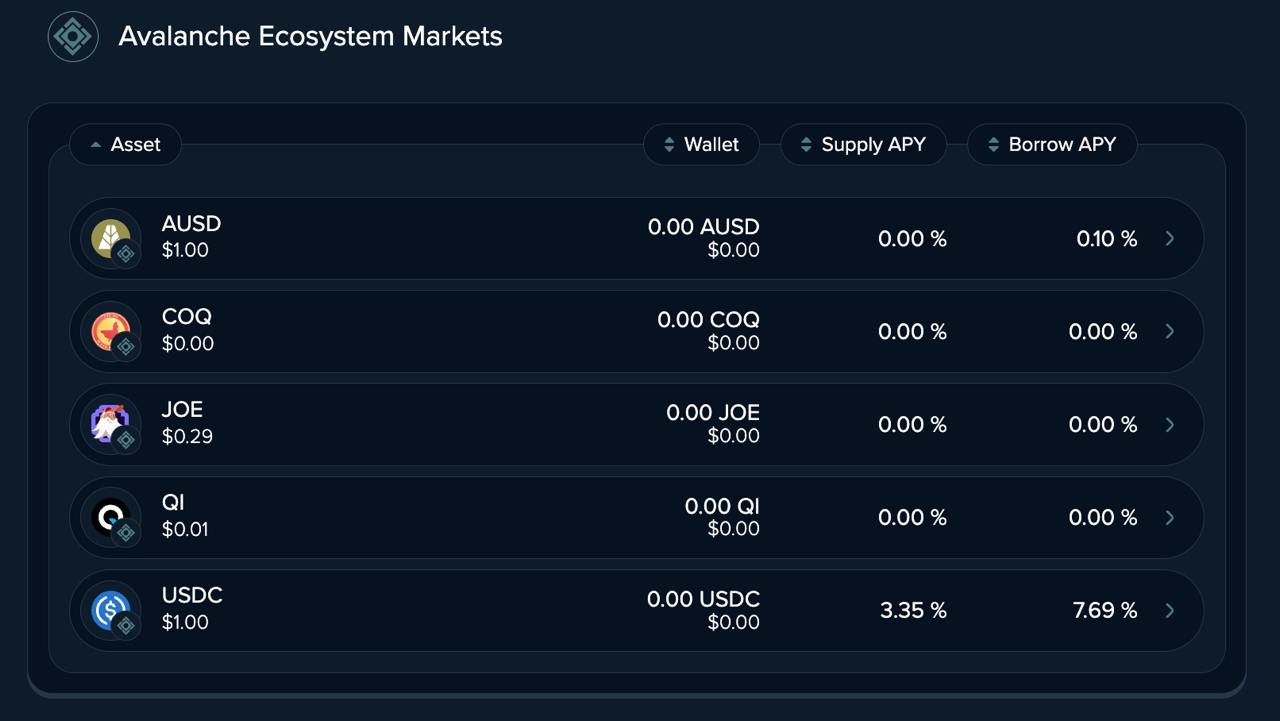
**Avalanche Ecosystem Markets** on BENQI provide a lending and borrowing environment separate from the Core Markets, specifically designed to support more exotic or volatile assets within the Avalanche ecosystem. By isolating these markets, BENQI allows users to engage with a wider variety of assets while maintaining risk management and protecting the core protocol from potential liquidity risks.

Each isolated market operates independently, ensuring that risks from one market, such as volatility or liquidity issues, do not affect others or destabilize the Core Markets.&#x20;

<figure><img src="/files/zSBHDDy4lahbOFGHlLXC" alt=""><figcaption></figcaption></figure>

### Key Features

* **Supporting Long-Tail and Exotic Assets:** Certain assets may not necessarily meet the liquidity or risk standards of BENQI's Core Markets. Avalanche Ecosystem Markets allow developers to introduce new markets as they please.
* **Collateralization and Interest Rate Models:** Just like in Core Markets, configurations for isolated markets are proposed and managed by Chaos Labs. This includes strict rules regarding collateralization ratios and interest rates, tailored for each individual asset to ensure optimal risk management.
* **USDC Loans Only:** Users can supply assets as collateral in an isolated market but may only borrow USDC. This prevents potential market manipulation or liquidity crunches that could hard ecosystem liquidity.&#x20;
* **Multi-Asset Repayments:** Loans can be repaid with multiple ERC20 tokens, provided they have sufficient liquidity. This ensures users have greater flexibility when managing their loans.

As with the Core Markets, the configurations are proposed by Chaos Labs (the team behind BENQI).

We recently introduced our RWA Platform, where each lending pool is structured as an Avalanche Ecosystem Pool. This platform expands BENQI's lending capabilities by integrating real-world assets into the Avalanche ecosystem. For more information visit [RWA PLATFORM](/rwa-platform/governance)


# Protocol Parameters

**The BENQI Core Team adjusts five key parameters** to ensure stability and maintain liquidity across the platform. Over time, this will be increasingly decentralized.

The five parameters include:

1. **Collateral Factor:** How much a user can borrow against a specific asset. A higher collateral factor allows users to borrow more, but also increases liquidation risk.&#x20;

For example, if AVAX has a collateral factor of 40%, and AVAX is priced at $100, the maximum amount that can be borrowed is $40 in other assets. A higher collateral factor means more can be borrowed but increases the liquidation risk.

2. **Reserve Factor:** The percentage of interest paid by borrowers that's kept by BENQI and allocated to the protocol's reserves for financial sustainability purposes. This reserve ensures that the protocol can remain stable and resilient in varying market conditions.

For example, with a reserve factor of 20%, 20% of the interest paid by borrowers is collected by the protocol, helping to maintain liquidity buffers and safeguard against potential liquidity shortages or market volatility.

3. **Close Factor:** The maximum amount to be liquidated in a single transaction.

For example, with a 50% Close Factor, up to 50% of a liquidatable account's debt can be liquidated in one transaction. If an account had $1,000 in debt that became eligible for liquidation, a liquidator could liquidate up to $500 in one go.

4. **Liquidation Incentive:** The reward provided to liquidators for closing under-collateralized positions and ensuring the protocol's sustainability.&#x20;

For instance, a 10% liquidation incentive means liquidators receive an additional 10% of the borrower's collateral as compensation for executing the liquidation. If a borrower is liquidated with $100 worth of collateral and the liquidation incentive is 10%, the liquidator would receive $110 in return for liquidating the position.

5. **Interest Rate Models:** BENQI’s interest rates are based on the utilization rate of each asset market, which refers to the ratio of total assets borrowed to total assets supplied. As utilization rates increase (i.e., more assets are borrowed), interest rates rise, incentivizing others to supply the asset while discouraging further borrowing to maintain liquidity. Conversely, when utilization is low, interest rates decrease to encourage borrowing.

BENQI currently uses the **Jump Rate Model**, which is more efficient at incentivizing liquidity at higher utilization rate, as illustrated in the following chart:

![Jump Rate Model](/files/9rscCdE6AbrkdSDVPhcX)


# Health & Liquidations

Health is a numeric indicator of the safety of a user’s collateralized position and represents the ratio between total deposited collateral and the total loan value.&#x20;

**When Health falls below 1, a liquidation is triggered**.&#x20;

This means that a portion of the user’s collateral is automatically sold to repay their loan and cover any associated fees. For example, in BENQI's Core Markets, if the collateralization ratio for AVAX is 50%, this means you can borrow up to 50% of the value of your AVAX deposit. If AVAX falls significantly in price, a liqudation may be triggered.

A higher Health value means the collateral is safer from liquidation. Health decreases when collateral loses value or when the borrowed debt increases.

To improve Health, users can repay part or all of the borrowed amount or add more collateral. The protocol also displays Health status using color-coded indicators:

* **Health > 2 (**<mark style="color:green;">**Green**</mark>**):** Collateral is safe from liquidation.
* **Health < 1.99 (**<mark style="color:orange;">**Orange**</mark>**):** Caution, collateral may be at risk.
* **Health < 1.1 (**<mark style="color:red;">**Red**</mark>**):** High risk of liquidation.
* **Health < 1:** Liquidation will occur.

For example, if the $AVAX collateral ratio is 70%, a user deposits $100 AVAX, and borrows $70. Their Health = 1.0, meaning they’re right at the liquidation threshold. Any further reduction in price will lead to their position being liquidated.&#x20;

## Liquidations In Action

When a position's Health falls below 1, a portion of the collateral will be liquidated to restore the loan to a safer position.&#x20;

BENQI uses a **Close Factor**, which limits the portion of the debt that can be repaid in a single liquidation transaction. For example, if the close factor is set to 50%, only up to 50% of the user’s debt can be liquidated at once. This prevents the total debt from being repaid in a single liquidation, allowing the user to retain some collateral and avoid complete liquidation of their assets.

Upon liquidation, liquidators repay a portion of the debt, and BENQI sells the corresponding amount of collateral. This includes a **Liquidation Incentive** (usually 10%) to reward liquidators, added to the amount of collateral taken. For example, if $50 of debt is liquidated with a 10% incentive, $45.5 worth of collateral would be paid to the liquidated party, and $4.5 would be given as a reward to liquidators.

Both the Close Factor and Liquidation Incentive are covered in greater detail in [Protocol Parameters](/benqi-markets/protocol-parameters)


# Getting Started

In this section, we will provide a walkthrough on how to get started with:

* **Depositing:** Supplying assets into either **Core Markets** or **Avalanche Ecosystem Markets.**
* **Borrowing:** Accessing liquidity by using deposited assets as loan collateral.

To borrow, one must first deposit assets.

## Dashboard & First Steps

To get started, visit [BENQI Markets.](https://app.benqi.fi/)

We have created a dashboard that provides an overview of all your positions. Upon connecting your wallet, you will be able to see:

* Your total **net worth**
* **Net APY** (Annual Percentage Yield)
* **Health Factor**, which reflects the safety of your collateralized positions
* **Available rewards** to claim
* **Supplied and borrowed assets** for real-time monitoring

<figure><img src="/files/RgBlSSvnxJT0GsIbIGEe" alt=""><figcaption></figcaption></figure>

### Depositing

To borrow, users must first deposit assets, which will act as collateral. Depositing assets in the **Core Markets** is required before borrowing or engaging in other market activities.

We provide a graphic below showing the interface. Based on this graphic, we will show how to get started in supplying your assets.

<figure><img src="/files/aEarEpCFtpmRAsv9gRcy" alt=""><figcaption></figcaption></figure>

### Steps to Deposit

1. **Select the Asset**: We'll use the graphic as an example. In this scenario, the user has selected **AVAX** from the drop-down list of available assets.
2. **Input the Amount**: Enter the amount of AVAX you wish to supply in the input field. You can also click the **Max** button to supply your entire AVAX balance.
3. **Enable Collateral (Optional)**: Toggle the "**Use as Collateral"** button if you'd like your deposited AVAX to be used as collateral for borrowing other assets. If you turn this on, your AVAX will be locked as collateral, affecting your **Health Factor** and borrowing power.
4. **Review the Details**: Check the values for **"Health After Supplying"** and **"Supply Balance,"** both located on the right side of the screen, to understand how your deposit will affect your overall position. Ensure that the **Collateral Factor** and any borrowing limits meet your needs.
5. **Confirm and Deposit**: After inputting the desired amount of AVAX, click the **Supply** button to confirm the transaction. This will initiate the deposit, and AVAX will be supplied to the protocol. You will start earning interest (displayed as **"Supply APY"**) based on deposited assets.

## Borrowing

Users may borrow funds once they have deposited assets. The reason for this is that the deposited assets act as collateral, ensuring that the loan is backed by sufficient value to mitigate the risk for both the borrower and the protocol.&#x20;

<figure><img src="/files/8iyqTH1hm8qmuNyBTkDb" alt=""><figcaption><p>The Borrow tab is where you can borrow assets, using previously deposited assets as collateral.</p></figcaption></figure>

### Steps to Borrow

Once users have deposited assets, they can take out a loan with their supplied assets as collateral.&#x20;

1. **Navigate to the Borrow Section**: In the BENQI Markets dashboard, switch from the "Supply" tab to the **"Borrow"** tab. Here, you’ll see the assets available for borrowing along with their corresponding borrow APY.
2. **Select the Asset to Borrow**: Choose the asset you’d like to borrow from the available list (e.g., QI or USDC). You’ll also see the **APY** for borrowing that asset, helping you understand the cost of your loan.
3. **Enter the Amount**: Input the amount of the asset you'd like to borrow, ensuring that the amount is within your borrowing limit based on the collateral you’ve supplied. Your **borrowing limit** will be displayed based on the collateralization ratio of your deposited assets.
4. **Confirm the Transaction**: After verifying the amount, click the **Borrow** button to initiate the transaction. Once the transaction is confirmed, the borrowed amount will be transferred to your wallet, and you will begin accruing interest on the borrowed funds.


# Overview

Stake AVAX without locking it up. Earn and freely use it within DeFi.

BENQI Liquid Staking is the leading liquid staking protocol built on Avalanche, surpassing $250M in Total Value Locked (TVL) by solving a critical issue: **illiquidity**.

Avalanche, as a Proof-of-Stake (PoS) network, enables users to earn rewards by staking AVAX tokens to secure the network. However, staking on the Avalanche Platform Chain (P-Chain) locks AVAX tokens, making them inaccessible and illiquid.&#x20;

**By issuing sAVAX, BENQI unlocks liquidity for staked AVAX, allowing users to engage in DeFi activities while earning passive staking rewards.**

BENQI also provides staking infrastructure solutions that make it easy for anyone to start running their own validators. We cover this in the [Ignite](/ignite/overview)section.

<figure><img src="/files/bohnHpkU7P8OtVX2bmgp" alt=""><figcaption><p>Users can stake AVAX for sAVAX and then deploy it for yield</p></figcaption></figure>

## **What is BENQI Liquid Staking?**

BENQI's liquid staking infrastructure tokenizing staked AVAX and allows users to freely use it within DeFi applications such as AMMs, lending & borrowing protocols, yield aggregators, etc. For example, one could stake their AVAX, receive sAVAX, and lend that out via BENQI Markets for yield.

Furthermore, rather than bridge funds from the C-Chain to the P-Chain (where staking occurs), BENQI BENQI allows users to stake AVAX directly on the C-Chain and then securely and automatically bridges assets over using MPC encryption.

Key benefits of staking AVAX via BENQI include:

* **DeFi Integrations**: sAVAX is integrated into various DeFi protocols, meaning users can earn both staking rewards and DeFi yields simultaneously. For instance, sAVAX could be lent through BENQI or a separate lending protocol for additional yield, supplied to any liquidity pool containing sAVAX (e.g. sAVAX/AVAX), and much more.
* **Cross-Chain Staking**: As Avalanche staking on occurs on the Avalanche P-Chain, users must normally bridge tokens from the C-Chain to the P-Chain. BENQI simplifies the staking process by allowing users to stake AVAX directly on the C-Chain, using secure MPC encryption to bridge assets to the P-Chain automatically. Without this integration, users would have to bridge their AVAX manually.
* **No Lock-Up Periods & Zero Fees**: Enjoy the flexibility to unstake your AVAX anytime without long-term commitments. There are also no fees for staking, depositing, or withdrawing your AVAX.

## What is sAVAX?

**sAVAX** is the token users receive when staking their AVAX on BENQI Liquid Staking. It represents their staked position and accrues interest from Avalanche staking rewards.

Users can exchange sAVAX for AVAX + staking rewards via the Unstake tab in the BLS app. The price of sAVAX increases over time based on the amount of staked AVAX in the pool and accrued rewards.

sAVAX Price = `total AVAX staked / total sAVAX minted * AVAX price`

For example, if there are 10,000 AVAX staked and 9,000 sAVAX minted, with the current AVAX price at $100, the sAVAX price would be approximately $111.11.

A few other pieces of information worth noting:

* **Transferability**: Unlike directly running or delegating AVAX to a node, sAVAX is transferable and can be used across DeFi applications like AMMs, lending platforms, and derivatives.
* **Unstaking**: AVAX can be unstaked anytime with a 15-day unlock period, during which sAVAX continues to accrue rewards. Rewards stop accruing only during the final 2-day redemption period after the unstake request is processed. For immediate liquidity, secondary markets offer instant swaps between sAVAX and AVAX based on the market rate.
* **Rewards Accrual**: sAVAX automatically accrues rewards based on the staking rate. For example, a 7.2% APR in staking rewards means your sAVAX will be worth 7.2% more in AVAX after one year.
* **Protocol Revenue**: While no fees are charged, the protocol earns 10% of the rewards generated by validators, including a portion of the delegator fees.


# Architecture

On this page, we'll provide an architectural overview of **BENQI Liquid Staking** based on the below graphic. We will explain how users can stake AVAX, receive sAVAX, and utilize it within DeFi while earning rewards.&#x20;

<figure><img src="/files/mEnswFOUpgWPnA5hanUi" alt=""><figcaption></figcaption></figure>

### **1. Staking AVAX with BENQI**

Beginning at the top of the graphic, users stake AVAX on the C-Chain and receive **sAVAX** tokens on the C-Chain, representing their staked AVAX.

This AVAX is then delegated to validator nodes on the Avalanche P-Chain, where it contributes to network security and earns staking rewards. Funds are secured via MPC encryption on the P-Chain and bridged to the C-Chain.

### **2. Earning and Redeeming Rewards**

Staked AVAX continues to earn rewards on the P-Chain, and the value of **sAVAX** accrues as these rewards accumulate.

To redeem AVAX, users can either:

* **Claim AVAX** directly through BENQI Liquid Staking with a **15-day cooldown period**, or
* **Instantly swap sAVAX for AVAX** on an Automated Market Maker (AMM) platform if they prefer immediate liquidity, though AMM fees may apply.

### **3. sAVAX DeFi Integrations**

The **sAVAX** token provides additional utility by allowing users to participate in decentralized finance (DeFi) protocols.

Users can use sAVAX in **BENQI Markets** or other DeFi platforms to earn extra yield, borrow against it, or engage in various DeFi activities.

This setup allows users to **maintain exposure to AVAX staking rewards** while also unlocking liquidity through DeFi, enhancing both yield opportunities and flexibility in asset management.


# Getting Started

This page serves as a comprehensive overview of our application, making it easy for anyone to get started. We will break this page down into three distinct sections:

1. **Staking & Unstaking:** A guide on how to get started.
2. **Key Metrics & Information:** How to interpret additional information on the web page.
3. **Claiming AVAX:** How to receive your staking rewards.

As a reminder, when you submit an unstake request, there’s a **15-day waiting period** before you can claim your AVAX, during which rewards continue to accrue. After the 15-day period, your AVAX will be claimable with a **2-day window to redeem it**.&#x20;

To access the application visit: [**https://staking.benqi.fi/stake**](https://staking.benqi.fi/stake)

## 1. Staking & Unstaking

Once you have gone to our application's [main page,](https://staking.benqi.fi/stake)  you will see an overview of your current AVAX and sAVAX balances, the current APR for sAVAX, and where to provide your desired transaction details (e.g. how much you wish to stake).

### To Stake:

* Connect your wallet & input the desired amount of AVAX to be staked
* Click `Stake`and receive AVAX in the same wallet

### To Unstake:

1. Connect your wallet & input the desired amount of [sAVAX](broken://pages/QUf2PbJaVUj2rAB8STuw) to be unstaked
2. Click on `Unstake`and your AVAX will be claimable after 15 days

<figure><img src="/files/N4kV7u54FXYigb03WNmZ" alt=""><figcaption><p>Connect your wallet and click either "Stake" or "Unstake" and provide as input the amount of either AVAX or sAVAX you wish to stake/unstake.</p></figcaption></figure>

## 2. Key Metrics & Information

This section is for lower down on the page, where there is other information, including:

* **Claim AVAX**: Where you can claim your AVAX rewards.
* **sAVAX APR**: The current rate.
* **Key Metrics**:
  * **APR** expressed in AVAX
  * **sAVAX Market Cap**
  * **Total AVAX Staked**
  * **Number of Unique Stakers**
* **Cooldown Period**: A reminder of the 15-day unstaking period.
* **Redemption Period**: A reminder of the 2-day window after the cooldown period for claiming unstaked AVAX.

<figure><img src="/files/S21uTkeKLK9chBy9W5wl" alt=""><figcaption><p>Additional Information Relating to BENQI Liquid Staking. </p></figcaption></figure>

## 3. Claiming AVAX

Although rewards are automatically accrued, to unstake your sAVAX, you must wait for 15 days.

On [the main page, ](https://staking.benqi.fi/stake)there is a **Claim** section where you can claim your AVAX if applicable. Once this time is up, you will have 2 days to withdraw.

We recommend setting an alert, such as in your Calendar, to avoid missing this 2-day period.

<figure><img src="/files/M4ZmkrLa8LPY34tJORKm" alt=""><figcaption><p><a href="https://staking.benqi.fi/stake">https://staking.benqi.fi/stake</a></p></figcaption></figure>


# Overview

Becoming an Avalanche primary network validator requires significant financial resources.&#x20;

BENQI provides a solution that streamlines and provides cost-effective infrastructure for anyone wishing to launch Avalanche primary network validators affordably.

**Pay-as-you-Go (PAYG):**  Ideal for short-term users such as MEV searchers. Users pay AVAX upfront, and BENQI provides the full 2,000 AVAX required for validator staking.

We cover this deeper in the [PAYG](/ignite/payg)section.


# PAYG

## Pay As You Go (PAYG)

Ignite offers a Pay As You Go (PAYG) model designed to reduce the capital requirements for launching an Avalanche validator.

With PAYG, no upfront AVAX stake is required. Instead, users can rent the AVAX needed for validation by paying a weekly fee, making it ideal for short-term users or experimenters such as MEV Solvers who want to run validators without committing significant capital. Rewards are minimal, and users are responsible for covering the hosting costs associated with running the validator.

<figure><img src="/files/mQvsNAynm3UXJniZULcm" alt=""><figcaption><p>PAYG is ideal for teams optimizing their operating expenses. There is a one-time fee, no staking requirement, and pricing begins at 8 AVAX per week.</p></figcaption></figure>

Users simply pay the required fee (in AVAX, USDC, or QI), input their NodeID, and select the staking duration. BENQI will provide the entire 2,000 AVAX needed to launch a validator, while the user earns no staking rewards but gains full access to the validator’s operation for the duration of the rental period.

This option is ideal for users who want to experiment with running a validator for a short period or do not have the full AVAX required to operate a validator. For example, MEV Solvers or projects testing out the market.

* **Minimum Stake**: 0 AVAX
* **Minimum Fee**: 8 AVAX per week.
* **Billing**: Charged at the start of each staking period, with a 5% discount for payments made in QI. The longer the staking duration, the lower the weekly cost.&#x20;

Two examples include:

* **2-week rental**: Pay 16 AVAX upfront, and BENQI will provide the full 2,000 AVAX required for validator staking for one week.
* **4-week rental**: Pay 30 AVAX upfront, and BENQI will provide the 2,000 AVAX for validator staking over a month.


# Getting Started

To get started with PAYG or Stake, beging by visiting [ignite.benqi.fi](https://ignite.benqi.fi)

Click on the **My Validators** tab located at the top left. From there, open the **Validator Option** box and select your cloud provider of choice.

At this point, you will be prompted to **Select Payment Method, choose:**

1. Pay As You Go

<figure><img src="/files/ThA3KAbFqT5klWAiAnAC" alt=""><figcaption></figcaption></figure>

### Pay As You Go

If you selected PAYG in Step 1, you will now:

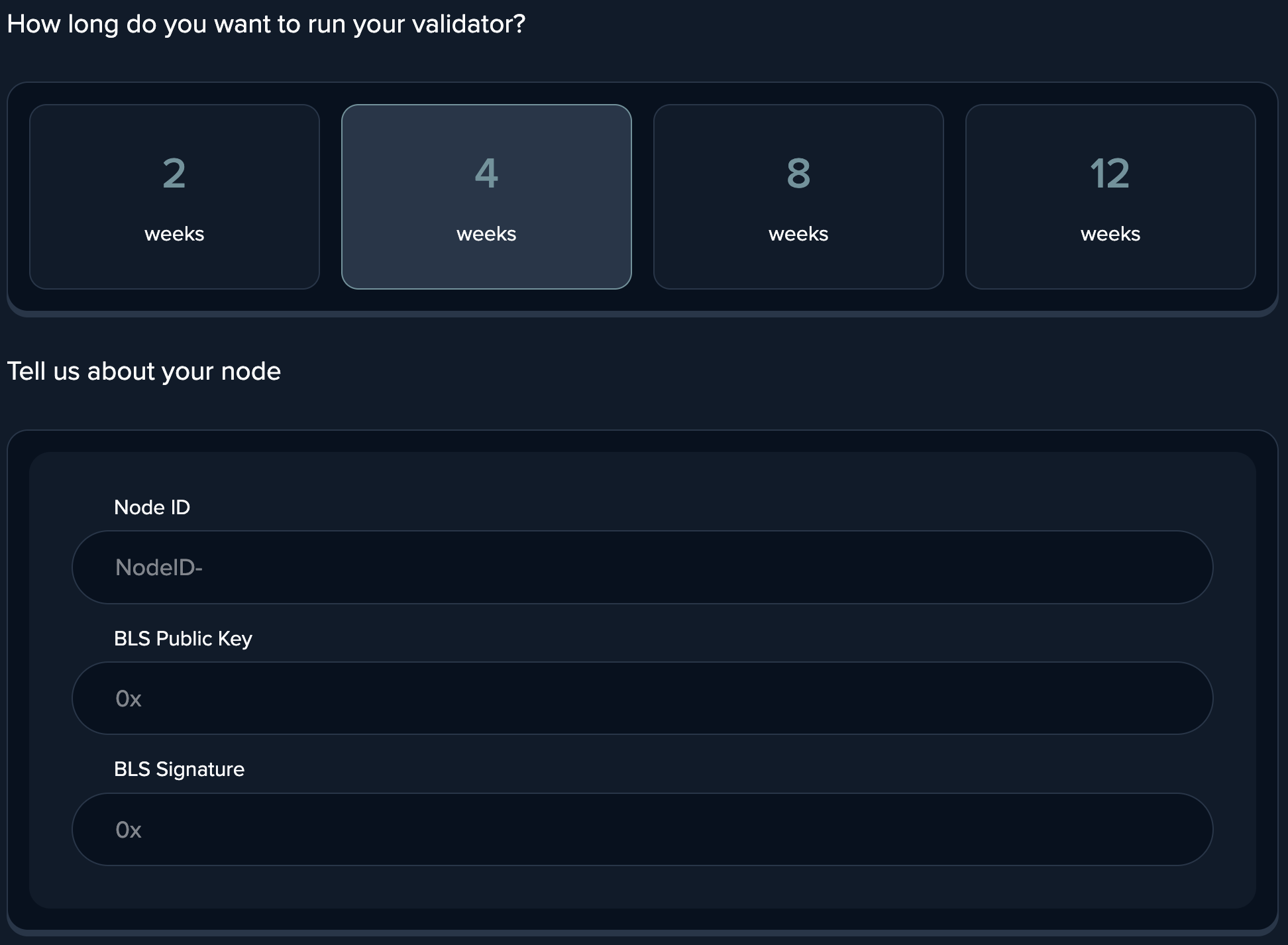
* **Select the Staking Duration:** Choose the length of time you'd like your validator to run by selecting between the options of 2 weeks, 4 weeks, 8 weeks, or 12 weeks.
* **Provide Node Detail:**&#x20;
  * Enter your **Node ID.** This is provided by the cloud service provider or platform where you are running your validator.
  * Input the **BLS ID Code**, which is specific to your node. It is usually generated when you configure your node's validator keys.
  * Provide the **BLS Signature** to verify your node and complete the process. Like the **BLS ID Code**, it can be found in the node's configuration files or provided by your cloud platform during the validator setup.

<figure><img src="/files/pucx4pU3lhkAqH8ZejCb" alt=""><figcaption></figcaption></figure>

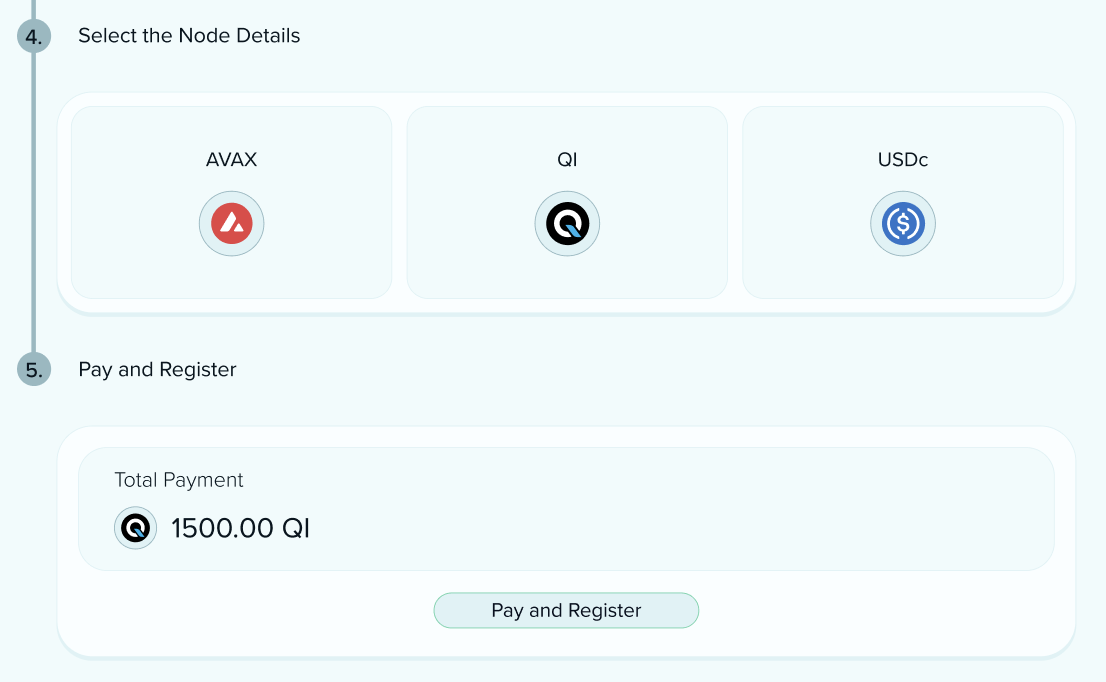
The next steps are:

1. **Select Node Details:** AVAX, QI or USDC
2. **Pay & Register**

<figure><img src="/files/oDex2g2soqGkkAeKymov" alt=""><figcaption></figcaption></figure>


# Overview

BENQI's liquid staking pool holds a large amount of AVAX that is reserved for earning protocol revenue via liquid staking. Given BENQI's focus on gradual decentralization, a key strategy is distributing staked AVAX to trustworthy Avalanche validators.

This is done via **Node Voting**, which allows holders of BENQI Miles tokens, including validators themselves, to vote regarding how AVAX is delegated from BENQI’s Liquid Staking Pool. Although BENQI Miles will be used for various use cases in the future, this represents an initial use case that increases decentralization and validator rewards.

{% hint style="info" %}
As a reminder, BENQI Miles are earned by staking QI, with an **accrual rate of 0.000003888888888 Miles per staked QI each second**. So over the course of one day (86,400 seconds), a user would earn approximately **336 BENQI Miles** for each staked QI.
{% endhint %}

There are two ways (subject to change) to accrue Miles:

1. **Flex Option:** What exists today. Miles accrue gradually over time as users stake their QI, with full benefits accumulating after a specified period.
2. **Lock Option:** A planned feature that has not yet been implemented. Miles accrue instantly upon staking, but users face a delayed exit period when they choose to unstake.

## Delegations

There are two delegation pools:

* **Open Pool (65%)**: Available to BENQI-selected validators that meet enhanced performance and infrastructure requirements to validate the Avalanche Network. Delegations within this pool are distributed among eligible high-spec validators. In the event of capacity constraints or overflow within the selected validator set, any validators that meet the minimum network requirements may receive delegations to ensure efficient capital deployment and network participation.
* **BENQI Miles Pool (35%)**: Available only to validators selected by BENQI Miles holders, with delegations distributed randomly based on the validator's aggregate vote count. This incentivizes validators to hold BENQI Miles to vote for themselves and receive additional delegations, though users may also vote for nodes.

<details>

<summary>Example: BENQI Miles Pool in Action</summary>

Lett’s say Validator A receives 2,000 votes from BENQI Miles holders, while Validator B receives 1,000 votes.&#x20;

In this setup, Validator A has twice the amount of support as Validator B. This means that, during each delegation cycle, Validator A will have a 66.7% chance of being selected to receive AVAX delegations from the pool, while Validator B will have a 33.3% chance.&#x20;

As a result, the higher the number of votes a validator receives, the greater their likelihood of receiving additional stake from the BENQI Miles Pool, allowing the community to influence which validators gain more network influence.

</details>

We cover this further in [Delegation Pools](/node-voting/delegation-pools)


# Delegation Pools

BENQI’s Liquid Staking operates with two distinct delegation pools:

1. **Open Pool**: Available to all validators who meet the minimum criteria.
2. **BENQI Miles Pool**: Available only to validators selected by BENQI Miles holders.

### Open Pool (65% of delegations)

This pool is for Avalanche validators who have staked at least **6,000 AVAX, have high spec hardware** and have at least **15 days of uptime**.

There is a 2% delegation fee, and delegations from this pool are allocated **randomly** to qualifying validators.

### BENQI Miles Pool (35% of delegations)

This pool is for Avalanche validators who hold **BENQI Miles** (formerly veQI), have staked at least **2,000 AVAX** and have at least **15 days of uptime**.

They may set their delegation fee between 2% and 5%. Validators with delegation fees above 5% are not eligible for delegations from this pool.

Delegations from this pool are randomly distributed based on the validator's **aggregate vote count of BENQI Miles**. For example, if Validator A has 10,000 Miles votes and Validator B has 5,000 Miles votes, Validator A will receive twice the delegations.

<figure><img src="/files/yctnmESuvn6S1EL4w83z" alt=""><figcaption><p>In the past, Avalanche validators were randomly delegated stake from BENQI's liquid staking pool. Now, it's divided between the Open Pool (65%) and BENQI Miles Pool (35%). Delegations from BENQI Miles Pool are randomly distributed based on the validator's <strong>aggregate vote count of BENQI Miles</strong>.</p></figcaption></figure>

### Examples

1. **2% Delegation Fee with No BENQI Miles Vote Power**

Some Avalanche validators meeting the minimum criteria will receive delegations from the Open Pool.

2. **2%** **Delegation Fee with BENQI Miles Vote Power**

Validators will receive delegations from both the Open Pool and the BENQI Miles  Pool.

* **Open Pool**: Delegations are allocated to selected validators and random validators who meet the requirements during delegation overflow situations.
* **BENQI Miles Pool**: Delegations are based on the validator’s total vote count.

3. **More than 2% but less than 5% Delegation Fee with BENQI Miles  Vote Power**

Validators will receive delegations exclusively from the BENQI Miles Pool, based on their vote count.

4. **More than 5% Delegation Fee**

Validators with a fee exceeding 5% are not eligible for any delegations from BENQI Liquid Staking.


# Getting Started

On this page we'll provide an overview on how to get started with Node Voting.

### **1. Stake QI to Accumulate BENQI Miles**

Begin by navigating to the ["Stake" tab](https://staking.benqi.fi/veqi/stake) on the BENQI Liquid Staking interface. Stake your QI tokens to start accumulating BENQI Miles, which are required for voting.&#x20;

Accumulated Miles will reflect your influence in the Node Voting process, allowing you to vote for validators who will in turn receive a greater share of delegations from the BENQI Miles Pool (35% of delegations).

### **2. Navigate to the Vote Tab & Select a Validator**

Once you have Miles, switch to the ["Vote" tab](https://staking.benqi.fi/veqi/vote) to participate in Node Voting. Here, you’ll see your total Miles balance and your voting power.

Choose an Avalanche validator from the available list or enter the NodeID of a specific validator you want to support. You can direct all your voting power to a single validator or split it among multiple validators based on your preference.

### **4. Confirm Your Vote Allocation**

Allocate your Miles to the chosen validator(s).&#x20;

The amount of AVAX delegated to a validator is determined by their total Miles votes from the community. Validators with more votes are more likely to receive AVAX delegations from the BENQI Liquid Staking Pool.


# Overview

BENQI’s upcoming RWA Platform will enable users to leverage tokenized real-world assets (RWAs) as collateral within the protocol.&#x20;

The platform will support various RWAs across various sectors, including tokenized Treasuries, real estate, commodities, and financial instruments. By depositing these RWA tokens as collateral, users can borrow stablecoins like USDC, unlocking liquidity without selling their underlying holdings.

### Core Benefits

1. **Additional Yield:** By lending out RWAs over BENQI, users can earn yield on their RWA positions while also using them as collateral to take out loans, providing yield and liquidity without having to sell one's assets.
2. **New DeFi Products:** Developers can build new DeFi applications leveraging BENQI's deep liquidity, such as projects focused on cross-chain yield optimization. To learn more visit [DEVELOPERS](/developers/overview)&#x20;
3. **Compliance:** BENQI is working exclusively with highly compliant projects and seeks to bring Web3 lending to Web2 projects.

This page will be launched shortly with more information.

Be the first to learn of new updates by[ following us here.](https://x.com/BenqiFinance?ref_src=twsrc%5Egoogle%7Ctwcamp%5Eserp%7Ctwgr%5Eauthor)


# Overview

The QI token is native to Avalanche and is at the core of the entire BENQI ecosystem.  **A core use case is staking QI to receive BENQI Miles (formerly veQI).**&#x20;

BENQI Miles can then be used for purposes such as:

* Directing AVAX delegations to validators, and
* governance

QI can also be used for yield (e.g. as collateral) and provides discounts for services such as launching a PAYG validator.&#x20;

Furthermore, holders of BENQI Miles can engage in [Node Voting](https://app.gitbook.com/o/-MVjIfedJgGlCPfTx3QP/s/-MViz_ikDZy4OemUj_VI/~/changes/358/node-voting/governance), whereby they can allocate their votes to support specific Avalanche validators, influencing how AVAX is delegated from BENQI’s Liquid Staking Pool.

## Gradual Decentralization

The founding team currently governs the protocol. As BENQI matures, the protocol will progressively be decentralized and eventually be governed by a DAO consisting of QI token holders and governance structures both on-chain & off-chain.

BENQI Miles will be used to vote on all aspects of BENQI. To begin, it has been applied to Node Voting, covered in [Node Voting](/node-voting/governance)

**The total supply of QI is 7,200,000,000 tokens.**&#x20;

We provide a full breakdown of the supply in the [Token Distribution & Vesting](/benqinomics/token-distribution) section.

## BENQI Miles

By staking QI, users receive BENQI Miles, formally known as veQI.

BENQI Miles can be used to vote in governance decisions, with the initial focus on **Node Voting** to support Avalanche validators.

All users begin with a BENQI Miles balance of zero. When QI is staked, Miles accrue linearly over time to 100 times the QI staked (eg: 1 QI = 100veQI).&#x20;

**The accrual rate is 0.000003888888888 Miles per staked QI each second**, and this accrual is automatic so there is no need to claim it. For example, over the course of one day (86,400 seconds), a user would earn approximately **336 BENQI Miles** for each staked QI.

However, **unstaking** any amount of QI will reset the user's entire accumulated veQI balance to zero.

<details>

<summary>Example: How BENQI Miles Accrue Over Time</summary>

Let's say a user stakes **1,000 QI** in BENQI.

* **Accrual Rate**: Each staked QI earns **0.00000388888888 BENQI Miles per second**.
* **Calculation**:
  * Over the course of one day (86,400 seconds), this user would earn approximately **336 BENQI Miles** (0.00388888888 × 86,400)&#x20;
* **Accumulation Over Time**:
  * If the user keeps their 1,000 QI staked for **30 days**, they would accumulate **10,080 BENQI Miles**: (336 per day × 30 days)
* **Reset Condition**: If the user decides to unstake any amount of their QI during this period, their entire BENQI Miles balance would reset to **zero**. This incentivizes users to keep their QI staked for longer to maximize their Miles balance.

</details>

<figure><img src="/files/llkaPzzKhKKPsNY1NP4N" alt=""><figcaption></figcaption></figure>


# BENQI Miles

**BENQI Miles**, formerly known as **veQI**, are governance tokens that represent a user’s stake and influence within the BENQI protocol.&#x20;

They're earned by staking QI tokens within the protocol and enable users to vote on various aspects of the protocol. As you stake QI, you accumulate Miles over time, which can then be used for an increasing number of potential use cases covered below.

## **Progressive Decentralization**

As BENQI matures, more aspects of the protocol will be governed by QI token holders both on-chain & off-chain. The founding team will bootstrap the initial release phase of BENQI.

BENQI Miles will be used to vote on all aspects of BENQI. To begin, it has been applied to Node Voting, covered in [Node Voting](/node-voting/governance)

Examples of other parameters (subject to change) where you could use BENQI Miles for voting in the future might include:

* The **Interest Rate Model**
* **New assets** that meet the risk requirements of the protocol&#x20;
* **Risk parameters** for over-collateralization and liquidation
* **Changes to the Liquidity Mining Program** to adjust incentives depending on market conditions&#x20;
* **Protocol improvements**&#x20;


# Token Distribution & Vesting

The **QI token distribution** is designed to foster active participation and engagement within the BENQI protocol. By encouraging balanced growth in both borrowing and lending pools, the protocol aims to maintain high market utilization while gradually decentralizing governance over time.\
\
QI tokens will be distributed targeted via [Liquidity and Community Incentives](/benqinomics/liquidity-mining) to achieve a balance of high market utilization and a wide distribution of governance participants. This is subject to changes via governance as the protocol evolves and market conditions change.&#x20;

Tokens have been distributed amongst various key parties:

* **Core Contributors (720M):**  Reserved for team members. August 2022 unlock, 1-year cliff, followed by quarterly vesting over 3 years
* **Foundation (1.08B):** Allocated for growth initiatives, partnerships, and to ensure the protocol’s stability. May 2022 unlock, 9-month cliff, followed by quarterly vesting over 3 years.
* **Exchange Liquidity (360M)**: Provides liquidity for QI token trading on decentralized and centralized exchanges. Varied distribution to maintain exchange liquidity.
* **Seed Round (426.96M)**: Allocated to early investors who provided initial funding and support. August 2021 unlock, monthly release over 2 years.
* **Private Sale Round (869.04M)**: Reserved for strategic partners and investors to help scale the project.
* **Public Sale Round A (439.2M)**: Open to the public, helping to onboard a wider community of users and governance participants. August 2021 unlock, monthly release over 1 year.
* **Public Sale Round B (64.8M)**: Immediate liquidity provided through a fully unlocked public sale. August 2021 unlock, fully unlocked at launch.

45% or 3,240,000,000 QI tokens will be distributed to the community and partners through BENQI's Liquidity Mining program, which uses QI to incentivize the platform’s growth.  This is now fully unlocked.

This is illustrated in the following chart:

<figure><img src="/files/TjKxiw4Gqs947iZ5veVE" alt=""><figcaption></figcaption></figure>

<table><thead><tr><th width="145">Category</th><th width="171">Total Amount (QI)</th><th width="153">Lockup Amount (QI)</th><th width="148">Unlock Amount (Aug 2024)</th><th width="153">Initial Unlock Date</th><th width="161">Unlock Schedule</th></tr></thead><tbody><tr><td><strong>Core Contributors</strong></td><td>720,000,0000</td><td>720,000,0000</td><td>Fully unlocked</td><td>Aug 2022</td><td>1-year cliff, quarterly vesting over 3 years</td></tr><tr><td><strong>Foundation</strong></td><td>1,080,000,000</td><td>1,080,000,000</td><td>Fully unlocked</td><td>May 2022</td><td>9-month cliff, quarterly vesting over 3 years</td></tr><tr><td><strong>Community Incentives</strong></td><td>3,240,000,000</td><td>3,240,000,000</td><td>Fully unlocked</td><td>Aug 2021</td><td>Varied (dependent on incentive programs)</td></tr><tr><td><strong>Exchange Liquidity</strong></td><td>360,000,000</td><td>360,000,000</td><td>Fully unlocked</td><td>Aug 2021</td><td>Varied (depending on market needs)</td></tr><tr><td><strong>Seed Round</strong></td><td>426,960,000</td><td>426,960,000</td><td>Fully unlocked</td><td>Aug 2021</td><td>Monthly release over 2 years</td></tr><tr><td><strong>Private Sale Round</strong></td><td>869,040,000</td><td>869,040,000</td><td>Fully unlocked</td><td>Aug 2021</td><td>Monthly release over 1 year</td></tr><tr><td><strong>Public Sale Round A</strong></td><td>439,200,000</td><td>439,200,000</td><td>Fully unlocked</td><td>Aug 2021</td><td>Monthly release over 1 year</td></tr><tr><td><strong>Public Sale Round B</strong></td><td>64,800,000</td><td>64,800,000</td><td>Fully unlocked</td><td>Aug 2021</td><td>Monthly release over 1 year</td></tr><tr><td><strong>Total</strong></td><td>7,200,000,000</td><td>7,200,000,000</td><td></td><td></td><td></td></tr></tbody></table>


# Liquidity and Community Incentives

**Liquidity Mining** in DeFi refers to users providing liquidity and, in return, being rewarded with the platform’s native tokens or other incentives.

BENQI's Liquidity Mining program uses QI to incentivize users and BENQI partners to contribute to the platform’s growth.

**BENQI has pledged 45% of tokens (3.24 billion)** to this program.

The Liquidity Mining program is subject to adjustments based on data-driven decisions. In the future, the governance framework will allow BENQI Miles token holders to propose and vote on changes to improve the incentive structure. As the protocol grows, liquidity mining parameters may be adjusted to optimize long-term sustainability and maximize value for the community.


# Contracts

Token Contract Address&#x20;

[QI (BENQI](https://snowtrace.io/token/0x8729438EB15e2C8B576fCc6AeCdA6A148776C0F5)[ token)](https://snowtrace.io/token/0x8729438EB15e2C8B576fCc6AeCdA6A148776C0F5)

```
0x8729438EB15e2C8B576fCc6AeCdA6A148776C0F5
```

[sAVAX (BENQI Staked AVAX)](https://snowtrace.io/token/0x2b2C81e08f1Af8835a78Bb2A90AE924ACE0eA4bE)

```
0x2b2C81e08f1Af8835a78Bb2A90AE924ACE0eA4bE
```

{% content-ref url="/pages/fIaAtbIDrbY0a9rXzD8A" %}
[Core Markets](/resources/contracts/core-markets)
{% endcontent-ref %}

{% content-ref url="/pages/CmoxZDySegTHmSOmUiVU" %}
[Isolated Markets (Avalanche Ecosystem Markets)](/resources/contracts/isolated-markets-avalanche-ecosystem-markets)
{% endcontent-ref %}

{% content-ref url="/pages/yqxu7HF2fMP5lZZv2XVM" %}
[Liquid Staking](/resources/contracts/liquid-staking)
{% endcontent-ref %}

{% content-ref url="/pages/QyasOEEIhiCahW3aCibo" %}
[Ignite](/resources/contracts/ignite)
{% endcontent-ref %}

{% content-ref url="/pages/YJd3bzwXouZeaLkYo5VK" %}
[Price Feeds](/resources/contracts/price-feeds)
{% endcontent-ref %}

## Subgraphs

{% embed url="<https://thegraph.com/hosted-service/subgraph/yhayun/benqi>" %}
BENQI Liquidity Market Subgraph
{% endembed %}


# Core Markets

## Comptroller

```
0x486Af39519B4Dc9a7fCcd318217352830E8AD9b4
```

## QiToken

[qiAVAX](https://snowtrace.io/address/0x5C0401e81Bc07Ca70fAD469b451682c0d747Ef1c)

```
0x5C0401e81Bc07Ca70fAD469b451682c0d747Ef1c
```

[qisAVAX](https://snowtrace.io/address/0xF362feA9659cf036792c9cb02f8ff8198E21B4cB)

```
0xF362feA9659cf036792c9cb02f8ff8198E21B4cB
```

[qiBTC.b](https://snowtrace.io/address/0x89a415b3D20098E6A6C8f7a59001C67BD3129821)

```
0x89a415b3D20098E6A6C8f7a59001C67BD3129821
```

[qiBTC](https://snowtrace.io/address/0xe194c4c5aC32a3C9ffDb358d9Bfd523a0B6d1568) (WBTC.e)

```
0xe194c4c5aC32a3C9ffDb358d9Bfd523a0B6d1568
```

[qiETH](https://snowtrace.io/address/0x334AD834Cd4481BB02d09615E7c11a00579A7909)

```
0x334AD834Cd4481BB02d09615E7c11a00579A7909
```

[qiLINK](https://snowtrace.io/address/0x4e9f683A27a6BdAD3FC2764003759277e93696e6)

```
0x4e9f683A27a6BdAD3FC2764003759277e93696e6
```

[qiUSDT](https://snowtrace.io/address/0xc9e5999b8e75C3fEB117F6f73E664b9f3C8ca65C)

```
0xc9e5999b8e75C3fEB117F6f73E664b9f3C8ca65C
```

[qiUSDC](https://snowtrace.io/address/0xBEb5d47A3f720Ec0a390d04b4d41ED7d9688bC7F)

```
0xBEb5d47A3f720Ec0a390d04b4d41ED7d9688bC7F
```

[qiUSDTn](https://snowtrace.io/address/0xd8fcda6ec4bdc547c0827b8804e89acd817d56ef)

```
0xd8fcDa6ec4Bdc547C0827B8804e89aCd817d56EF
```

[qiUSDCn](https://snowtrace.io/address/0xB715808a78F6041E46d61Cb123C9B4A27056AE9C)

```
0xB715808a78F6041E46d61Cb123C9B4A27056AE9C
```

[qiDAI](https://snowtrace.io/address/0x835866d37AFB8CB8F8334dCCdaf66cf01832Ff5D)

```
0x835866d37AFB8CB8F8334dCCdaf66cf01832Ff5D
```

[qiBUSD](https://snowtrace.io/address/0x872670ccae8c19557cc9443eff587d7086b8043a)

```
0x872670CcAe8C19557cC9443Eff587D7086b8043A
```

[qiQI](https://snowtrace.io/address/0x35Bd6aedA81a7E5FC7A7832490e71F757b0cD9Ce)

```
0x35Bd6aedA81a7E5FC7A7832490e71F757b0cD9Ce
```

## QI - WAVAX Trader Joe JLP token

```
0x2774516897AC629aD3ED9dCac7e375Dda78412b9
```

## QI - WAVAX Pangolin PGL token

```
0xE530dC2095Ef5653205CF5ea79F8979a7028065c
```

## LP Staking Contract

```
0x784DA19e61cf348a8c54547531795ECfee2AfFd1
```

## QiErc20Delegate

```
0x76145e99d3F4165A313E8219141ae0D26900B710
```

For qiUSDTn, qiUSDCn

```
0xF28043598A1824053097d5C4FedD7CD1cf731E76
```

## QiTokenSaleDistributorProxy

```
0x77533A0b34cd9Aa135EBE795dc40666Ca295C16D
```

## Maximillion

Used to repay AVAX loans in full - allows sending more AVAX as repayment as necessary, transfers excess back to the user.

```
0xd78DEd803b28A5A9C860c2cc7A4d84F611aA4Ef8
```


# Isolated Markets (Avalanche Ecosystem Markets)

## Comptroller

```
0xfc8C7271BdC3816D7AB1fc802216bad387692Ce1
```

## Unitroller

```
0xD7c4006d33DA2A0A8525791ed212bbCD7Aca763F
```

## qiAvalancheEcosystemMarketsUSDC

```
0x6B35Eb18BCA06bD7d66a428eeb45aC7d200C1e4E
```

## qiAvalancheEcosystemMarketsCOQ

```
0x0eBfebD41e1eA83Be5e911cDCd2730a0CCEE344d
```

## qiAvalancheEcosystemMarketsJOE

```
0x4036cb0D6BF6b5F17Aa4e05191F86D4b1655b0d9
```

## qiAvalancheEcosystemMarketsQI

```
0x545356e396350D40cDEa888ad73534517399BF96
```

## qiAvalancheEcosystemMarketsSolvBTC

```
0x0fFAc5aae14E28E79C5CCc7a335D8C70Ee458A3A
```

## qiAvalancheEcosystemMarketsAUSD

```
0xb7CfB8Ae67E20059021A0D20fc30311a6c67C734
```

## QiERC20Delegate

```
0xc9a487f87a8E2320b251D28475dFAb44A42e3c69
```

## MultiRewardDistributor

```
0x9F21eB10b7Bc56a7d7879E67fB7BAC415EaFb973
```

## MultiRewardDistributorImpl

```
0xD955aD95185AB094415CAE19Bf923d5F9DC9BD80
```

## MultiRewardDistributorProxyAdmin

```
0x177e073bBDdF20e654758b0F08B6D7c9195E90c8
```


# Liquid Staking

Contracts for BENQI's Liquid Staking Protocol

## **sAVAX Contract Address**

[sAVAX (BENQI Staked AVAX)](https://snowtrace.io/token/0x2b2C81e08f1Af8835a78Bb2A90AE924ACE0eA4bE)

```
0x2b2C81e08f1Af8835a78Bb2A90AE924ACE0eA4bE
```

## veQI Contract Address

[veQI Contract](https://snowtrace.io/address/0x7Ee65Fdc1C534A6b4f9ea2Cc3ca9aC8d6c602aBd)

```
0x7Ee65Fdc1C534A6b4f9ea2Cc3ca9aC8d6c602aBd
```


# Ignite

## Ignite Contract Address

[Ignite Contract](https://snowtrace.io/address/0xB71a820d80189073F69498010cb67bDDAe050633)

```
0xB71a820d80189073F69498010cb67bDDAe050633
```


# Price Feeds

BENQI uses a dual oracle model for price feeds, utilizing Chainlink as the primary source, and Edge Oracles by Chaos Labs as secondary.

**QI (BENQI token)**

Chainlink&#x20;

<pre><code><strong>0x36E039e6391A5E7A7267650979fdf613f659be5D
</strong></code></pre>

Edge Oracle

```
0xcF1E5c990943B7AF4671EddF336a3Ad5277E59BC
```

**sAVAX (BENQI Staked AVAX)**

Chainlink

```
0x2854Ca10a54800e15A2a25cFa52567166434Ff0a
```

Edge Oracle

```
0x6A5B3ab3274B738eAB25205aF6e2d4dd77812924
```

**solvBTC (Solv Protocol BTC)**

Chainlink

```plaintext
0xfA5210B2584Cc625883fE1431188e4E086052205
```

Edge Oracle

<pre class="language-plaintext"><code class="lang-plaintext"><strong>0x354106DADacF4AfC8Eee9EB8DB1C5bb76A07DBad
</strong></code></pre>

**AVAX (Avalanche)**

Chainlink

```
0x0A77230d17318075983913bC2145DB16C7366156
```

Edge Oracle

```
0x66A8cb6c4230B044378aC3676D47Ed4fE18e3cFB
```

**USDT(USD Tether)**

Chainlink

```
0xEBE676ee90Fe1112671f19b6B7459bC678B67e8a
```

Edge Oracle

<pre><code><strong>0xB6dd1c91F352b7c1483370EfB7bE1E06549F2F23
</strong></code></pre>

**USDC (Circle USD)**

Chainlink

```
0xF096872672F44d6EBA71458D74fe67F9a77a23B9
```

Edge Oracle

```
0xCfFA8B54D01962bFDA2c6c06229F576E8a38972c
```

**COQ (Coq-Inu)**

Chainlink

```
0x5B4712ce553E94d9b22bA3CfA10CB6F32fb828E0
```

Edge Oracle

```
0xde12E956aa65E0581E9C470AcE2a8194987A8935
```

**BTC.b (Bitcoin Avalanche-bridged)**

Chainlink

```
0x2779D32d5166BAaa2B2b658333bA7e6Ec0C65743
```

Edge Oracle

```
0x7f92CABC6AFf6D24E36a7115d6A3c32Fb9B07466
```

**WETH.e (Wrapped ETH Ethereum-bridged)**

Chainlink

```
0x976B3D034E162d8bD72D6b9C989d545b839003b0
```

Edge Oracle

```
0xC33FD9cC294371398a6C7880A05F6B039F3a138C
```

**JOE (LFJ)**

Chainlink

```
0x02D35d3a8aC3e1626d3eE09A78Dd87286F5E8e3a
```

Edge Oracle

```
0x09352661B82d13699272412543EE15b3b48E9679
```

**AUSD (Agora USD)**

Chainlink

```
0x5C2d58627Fbe746f5ea24Ef6D618f09f8e3f0122
```

Edge Oracle

```
0x46Ec14c96443458035062c4804E15E2433dfF403
```

**DAI.e (DAI Ethereum-bridged)**

Chainlink

```
0x51D7180edA2260cc4F6e4EebB82FEF5c3c2B8300
```

Edge Oracle

```
0x2eEcA8c0A0112a869b22a997908AaF4b44082491
```

**LINK.e (Chainlink Ethereum-bridged)**

Chainlink

```
0x49ccd9ca821EfEab2b98c60dC60F518E765EDe9a
```

Edge Oracle

```
0x8dE6fD5AE468ba7a21b3D4869B281C9C999e4208
```

**WBTC.e (Wrapped Bitcoin Ethereum-bridged)**

Chainlink

```
0x86442E3a98558357d46E6182F4b262f76c4fa26F
```

Edge Oracle

```
0x178b8eda2c4c8a11f6b8657d3a0cd21c99be85ae
```


# Risks & Audits

## Smart Contracts Risks

The protocol will be interacting with a number of smart contracts, all of which imposes risks. This can be both known and unknown risks that could result in the failure or vulnerability on the smart contracts which could result in assets being locked or lost forever.

## Liquidation Risks

Assets that are supplied or borrowed on the protocol could fluctuate in value due to the systemic risks of the issuing platforms or market volatility, including the loss of peg of certain pegged assets. This could result in the liquidation or closing of a user's position.

## Risk Assessment & Management

BENQI works closely with [Chaos Labs](https://community.chaoslabs.xyz/benqi) on the risk assessment and management of assets for the BENQI Liquidity Market (BLM) to safely maximize capital efficiency. The BENQI Chaos Labs Dashboard displays risk monitoring done on BENQI Liquidity Market

{% embed url="<https://community.chaoslabs.xyz/benqi/ccar/overview>" %}

## Risks Associated with Protocol Functions

1\. Protocol parameter updates

BENQI distributes signing authority across multiple parties through a multisig framework. Protocol parameters, including interest rate models, collateral factors, asset listings, and liquid staking related functions, may be updated through this framework in accordance with the protocol's designated procedures and, where applicable, with input from BENQI's risk and security partners.\
\
What this means for you: The multisig framework is intended to reduce the risk of unilateral action by any single party. However, if a sufficient number of signers are compromised through phishing, key theft, social engineering, or misconduct, an unauthorized actor could:

* Modify protocol parameters (e.g., collateral factors, liquidation thresholds, staking delegation rules)
* Approve harmful assets or transactions
* Redirect staked AVAX
* Disable or interfere with protective measures

Security audits assess smart contract code but do not protect against signer compromise or misuse of authorized functions.

2\. Upgrade Risks

Certain protocol contracts, including those governing the lending markets and liquid staking, are upgradeable. Where an upgrade is implemented, the revised contract logic may alter how the protocol behaves, including how your positions, deposits, staking, or withdrawals are processed. Upgrades may introduce risks that did not exist in the prior version. You should review the protocol's current upgrade framework and associated permissions before depositing assets.\
\
3\. Emergency Response Functions

The protocol includes functions designed to respond to exploits, technical failures, or market disruptions. These may include the ability to pause markets, pause staking or redemptions, adjust parameters on an accelerated timeline, or restrict certain operations.

While intended as protective measures, these functions may themselves create or introduce risks. If exercised improperly, compromised, or triggered erroneously, they could affect your ability to withdraw assets or redeem sAVAX, alter your position value, or result in losses.\
\
4\. Multi-Party Computation (MPC) Infrastructure

Avalanche staking requires the cross-chain transfer of AVAX. To manage these transfers securely, BENQI uses an off-chain Multi-Party Computation (MPC) protocol. This distributes signing authority across multiple geographically independent nodes, requiring a minimum threshold of nodes to collaborate to approve any transaction.

What this means for you:

* Threshold Compromise: If a coordinated attack successfully breaches the required threshold of independent nodes simultaneously, whether through server exploits, software vulnerabilities, unauthorized access, or physical security breaches, an attacker could generate valid signatures to cause loss or misdirection of staked assets.
* &#x20;Operational Halts: If too many nodes experience simultaneous outages, due to severe network or infrastructure failures, and the signing threshold cannot be met, operations like staking, unstaking, and cross-chain transfers will be temporarily paused until the network is restored.

Acknowledgment

By using BENQI, including its lending markets and liquid staking protocol, you acknowledge that your assets may interact with smart contracts and related systems that are subject to certain upgrade, maintenance, and emergency response functions implemented through a multisig framework. You further acknowledge that the exercise, misuse, compromise, or failure of such functions could adversely affect protocol operations, asset availability, user positions, or result in losses. These risks, together with validator risks, MPC risks, redemption delays, and exchange rate deviations specific to liquid staking, are distinct from, and may arise independently of, risks associated with smart contract vulnerabilities, liquidations, or market conditions.

## Audits

BENQI will be continuously pursuing security audits for the protocol. However, security audits don't eliminate risks completely. Please do not supply your life savings, or assets you can’t afford to lose, to BENQI, especially as a liquidity provider.

### **BENQI Liquidity Market**&#x20;

Smart Contract Audit by Halborn (May 2021)

{% file src="/files/61zZBo3ZgpVSwhEmR10w" %}
Smart Contract Audit by Halborn
{% endfile %}

### **BENQI Liquid Staking**

Smart Contract Audit by Halborn (November 2021 - February 2022)

{% file src="/files/m9B80MTjiS58xUFn8shN" %}
Smart Contract Audit by Halborn
{% endfile %}

BENQI Liquid Staking Formal Verification by Certora (April 2022)

{% file src="/files/MX49GmqmzcpRi8FeFysa" %}
sAVAX Smart Contract Formal Verification by Certora
{% endfile %}

AAVE v3 sAVAX Formal Verification and Listing Stewards Audit by Certora (June 2022)<br>

{% file src="/files/s3f1niIJDBL346el53Qm" %}
sAVAX on AAVE v3 Formal Verification by Certora
{% endfile %}

### Ignite

Ignite Security Analysis by Cyfrin (December 2024)

{% file src="/files/3mQm6IQDIoDce2lXUDkM" %}

Ignite Security Analysis by Dedaub (March 2023)

{% file src="/files/MUw3bECKtQsmBsz1WMdI" %}
Ignite Smart Contract Audit by Dedaub
{% endfile %}

### BENQI Isolated Markets

BENQI Isolated Markets Audit (2024)

{% file src="/files/Dd5sD3Sv2IfNoh2U1cuG" %}

Moonwell code4rena Analysis (October 2023)

{% embed url="<https://code4rena.com/reports/2023-07-moonwell>" %}

Moonwell Finance Smart Contract Security Assessment (August 2023)

{% file src="/files/ew9DIR6oIQwK9OFiNA42" %}

### Chaos Labs Dual Oracle Contract (May 2025)

{% file src="/files/GgOV5kzOS5dSkXJ76wOS" %}


# Media Kit (Logos & Graphics)

{% file src="/files/lywVX7wsmGj6uAWycziV" %}

<figure><img src="/files/TrGuuSdQtu6wGUy0sKxt" alt=""><figcaption></figcaption></figure>

Files for ➡️ [BENQI branding](https://drive.google.com/drive/folders/1k-MTC7C5g92mW7Fk7eZRnGwDPY7nE5sS?usp=sharing)

<figure><img src="/files/Frkpxa58IzYziyHQ0kxX" alt=""><figcaption></figcaption></figure>

Files for ➡️ [QI icons](https://drive.google.com/drive/folders/1eek27JFpwn25FVd6x_iXkQNe1OyeDOIZ?usp=sharing)

<figure><img src="/files/zQMiqLyg0dvZ0SHulR6g" alt=""><figcaption></figcaption></figure>

Files for ➡️ [sAVAX icons](https://drive.google.com/drive/folders/14PjXb6duUXelTjk0gEGiVoM1fCBX_uv5?usp=sharing)

<figure><img src="/files/EdlqJ3NAWVlPf0b1px4L" alt=""><figcaption></figcaption></figure>

Files for ➡️ [Ignite](https://drive.google.com/drive/folders/1SRozQNTeLP1n98p855a7gU1XiJekeMo3?usp=drive_link)

Files for ➡️ [Wrapped qiTokens icons](https://drive.google.com/drive/folders/10fEO0or-GaFqVaJh0xWgnzd0VirKzFaX?usp=sharing)